
Read from the AVS conditions on 24 September 2026
What It Takes to Import Dog to Singapore, Country by Country
Import dog to Singapore and the exporting country sets the wait. The Animal and Veterinary Service sorts every country into one of three rabies risk schedules: a dog from Schedule I serves no quarantine at all, while a dog from Schedule III serves at least 30 days.
- Schedule I
- No quarantine
- Schedule III
- 30 days or more
- Import licence
- S$50, valid 90 days
- Minimum age
- 12 weeks at export
Everything below is what AVS publishes, with the date we read it. It is not advice on your import. What we can answer is the other half: whether a puppy already on sale here came in this way.
59 Sungei Tengah Road, Block L #01-19, Singapore 699014
The short answer
What are the requirements for bringing a dog to Singapore?
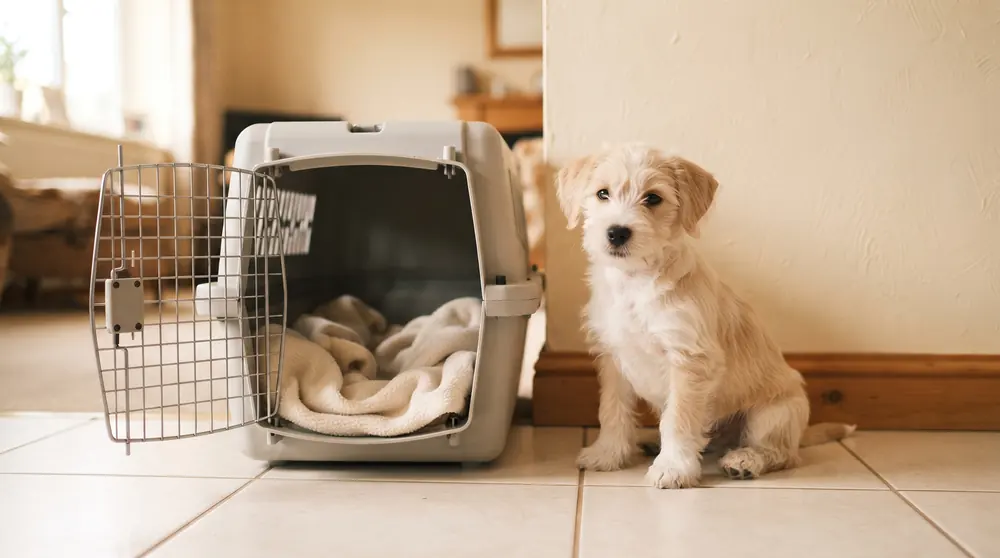
To import dog to Singapore, AVS wants an ISO microchip, an animal at least 12 weeks old at export, valid core vaccinations, a Singapore dog licence, an import licence, a Customs permit, a booked inspection and an endorsed health certificate[1] . Rabies steps follow the country category.
Why the exporting country decides almost everything
AVS sorts countries and regions by rabies risk, not by distance, airline or breed. That one classification sets the vaccinations, the blood tests, the parasite treatments and the quarantine.
AVS also says plainly that the categorisation is subject to change and asks importers to recheck its page close to the date of import. Every schedule claim below therefore carries the date we read it.
The categorisation
Schedule I, Schedule II and Schedule III, read as three different waits
Same paperwork, same fees, three completely different calendars.
What each schedule asks of a dog
Schedule I asks for no rabies vaccination, no serology test and no post-arrival quarantine, provided the animal is fully compliant with the rest of the veterinary conditions.
Schedule II asks for a valid rabies vaccination and a serology test, then waives quarantine only where two conditions are met. Schedule III asks for all of it, a rabies dose on arrival, and at least 30 days at the Animal Quarantine Centre[1] .
Minimum post-arrival quarantine by country schedule
AVS import rules put four countries in Schedule I
Schedule I holds Australia, New Zealand, the Republic of Ireland and the United Kingdom. Schedule II lists 31 countries and regions, among them the USA, Japan and Hong Kong SAR. Schedule III is defined as everything else, which includes Malaysia[1] .
The limitation belongs in the same breath: schedule membership is AVS’s to change. We re-read the list on 24 September 2026 against a page last updated on 21 September 2026, and the four Schedule I countries were unchanged.
Can I bring my dog to Singapore from Malaysia by car?
Lawfully, yes, and dogs entering by land are inspected at Tuas Checkpoint. The catch is the category: Malaysia appears in neither Schedule I nor Schedule II, so the Schedule III conditions apply in full.
The same logic runs in reverse: AVS states that a Singapore dog taken across for a holiday comes back as an import from Malaysia, with the 30-day quarantine attached.
Sequence matters more than speed
The order the steps must run in to import dog to Singapore
Two of the eleven steps are pure sequence. The dog licence is obtained on the Pet Animal Licensing System first, and only then may the import licence be applied for on the GoBusiness Licensing Portal.
Microchip first, then the core vaccinations
The microchip implant goes in before the vaccinations that will be certified, and it must comply with ISO standard 11784 or ISO standard 11785 Annex A. Its number then has to appear on every vaccination and treatment record.
- Dogs need valid vaccination against canine distemper virus, canine adenovirus type 1 and canine parvovirus type 2.
- A valid record shows the microchip number, the date, the vaccine brand and batch and the vet’s signature.
- Validity follows the manufacturer’s own recommendations on dose count and spacing.
That record is read again after arrival, this time against the local guidance on how the Singapore puppy vaccination series is read, which is where an early-finish course abroad gets settled[7] .
Rabies vaccination, then a blood test, then a wait of at least 90 days
Blood sampling for rabies serology happens at least 28 days after a valid rabies vaccination. The sampling itself must fall at least 90 days, and within 12 months, before the date of export[1] .
The test runs at a reference laboratory of the World Organisation for Animal Health, or at an approved laboratory in a Schedule I or Schedule II country. This one clause is why imports are planned in months.
The rabies clock, counted from the vaccination date
The money question
How much does it cost to import a dog to Singapore?
Two of the fees are published and fixed, and the rest are not ours to quote. The import licence costs S$50 on normal service, where issuance follows two working days after a complete submission, or S$100 on express service at one working day[1] .
The fee people do not budget for
Bringing a dog for inspection without an appointment costs S$133 per hour or part thereof. The appointment is free if you book it at least five days before arrival, which makes this the easiest charge on the whole process to avoid.
Everything private stays unquoted here. Airline carriage, the crate, an agent’s fee and the daily quarantine accommodation charge all vary, and a forum figure is one person’s quote rather than a price list.
- Import licence, normal service
- S$50
- Import licence, express service
- S$100
- Inspection without an appointment
- S$133 an hour
- Licence validity
- 90 days, no extension
Can I get GST relief for importing a pet into Singapore?
A Customs In-Payment permit for Goods and Services Tax may be required before arrival, and it is valid 10 working days from the approval date. The procedure differs depending on whether the owner travels on the same transport.
Relief is Singapore Customs’ decision under its change-of-residence rules rather than an AVS one, so that is the office to put the question to.
The longest line item
Quarantine is 30 days, 10 days or none at all
The Schedule II exemption is the part most summaries get wrong. It is not bought and it is not applied for on arrival: it is a pair of conditions the pet either meets or does not.
| Schedule | Post-arrival quarantine | What decides it |
|---|---|---|
| Schedule I | None | Full compliance with the veterinary conditions |
| Schedule II | None, or at least 10 days | Arrival within 5 days of the owner’s entry, and 6 months at the same address |
| Schedule III | At least 30 days | Category alone; a rabies dose is also given on arrival |
A pet on a personal import licence that misses both conditions serves at least 10 days of home quarantine, applied for in advance. A pet imported on a commercial licence serves its 10 days at the centre instead[1] .
Booking the space before the blood test result is even used
Quarantine space is reserved through the Quarantine Management System once the serology result is ready, and the microchip number, rabies records and antibody report all go in with the reservation.
- The deposit equals 10 days of quarantine fees plus transport from the border checkpoint.
- A confirmed reservation is held for up to 3 days past the allocated date.
- Cancel and the deposit is gone; amend inside 30 days of arrival and an amendment fee applies.
The quarantine centre is a few minutes from our gate
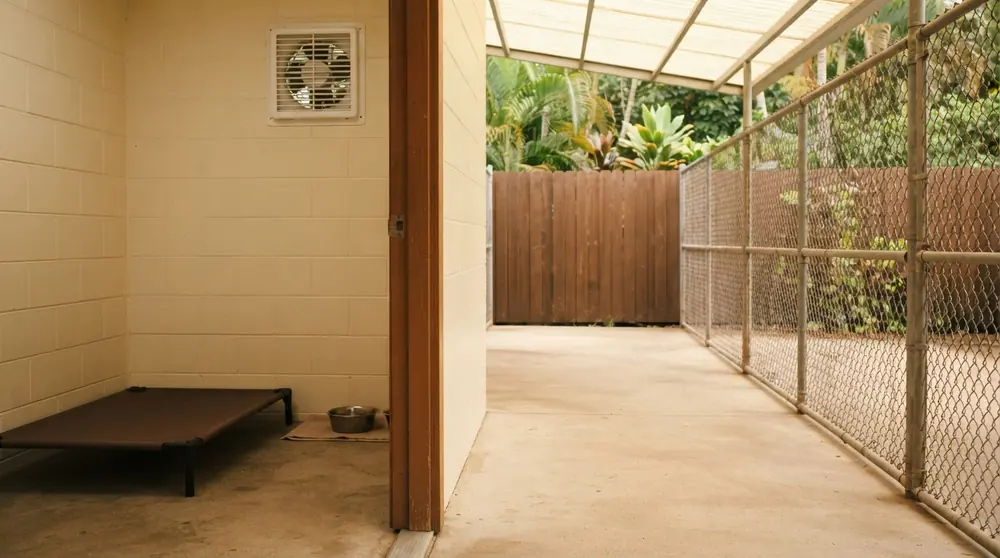
The Animal Quarantine Centre sits at 2 Jalan Lekar, nearest station Choa Chu Kang, in the same north-western corner of the island as this farm at 59 Sungei Tengah Road.
Release runs between 10:00 and 12:00 on the release date and the stay cannot be extended. Not one relocation page we crawled says where the centre actually is.
Two separate permissions
Breeds that cannot be imported, and what a flat allows
A licence to bring the dog in is not a permission to keep it where you live.
AVS publishes a list of dog breeds that may not be imported at all: Pit Bull types, including the American Pit Bull Terrier, the American Staffordshire Terrier, the Staffordshire Bull Terrier and the American Bulldog, plus Akita, Boerboel, Dogo Argentino, Fila Brasileiro, Neapolitan Mastiff, Tosa and Perro de Presa Canario.
- Crosses of any of those breeds are covered by the same prohibition.
- A mixed or cross breed import needs a colour photo showing the dog’s face and body in the licence application, so AVS can check it is not a prohibited breed.
The second permission is the address, which belongs to the Housing and Development Board. An HDB flat may keep one non-specified dog and no specified dog, while non-HDB premises allow up to three cats or dogs in total, of which only one may be a specified dog[1, 2] .
The other half of the question
Some puppies advertised in Singapore were imported
Most people reading about imports are not moving house. They are standing at a pen looking at the end of one of these routes, and nobody has told them so.
We breed Corgis, Cavapoos and Dachshunds on the licensed premises here and source the other breeds from licensed breeders, including Australian, UK and Irish lines. Those three happen to be Schedule I countries, which is not a coincidence.
What we tell buyers about where a puppy was bred
A sourced puppy is never described here as bred on the premises. In our August 2026 listing snapshot the Cavapoo pens ran 51 local, 33 from Australia, 14 from the United Kingdom and 2 from Ireland.
Ask which breeder, which country and which route, and expect an answer from a record rather than from memory. See the current mix across our puppies and prices by breed, where an imported Australian line sits at the top of the Corgi band.
Clause 18 and clause 24: the permit and the 72-hour rest
Search dog import Singapore and every result is written for someone moving with their own dog. Two clauses in the pet shop licence conditions are written for you instead, and neither is quoted anywhere in that SERP.
- Clause 18 keeps the proof at the counter. For an imported animal, the licensee must keep a copy of the AVS import permit at the shop[3] .
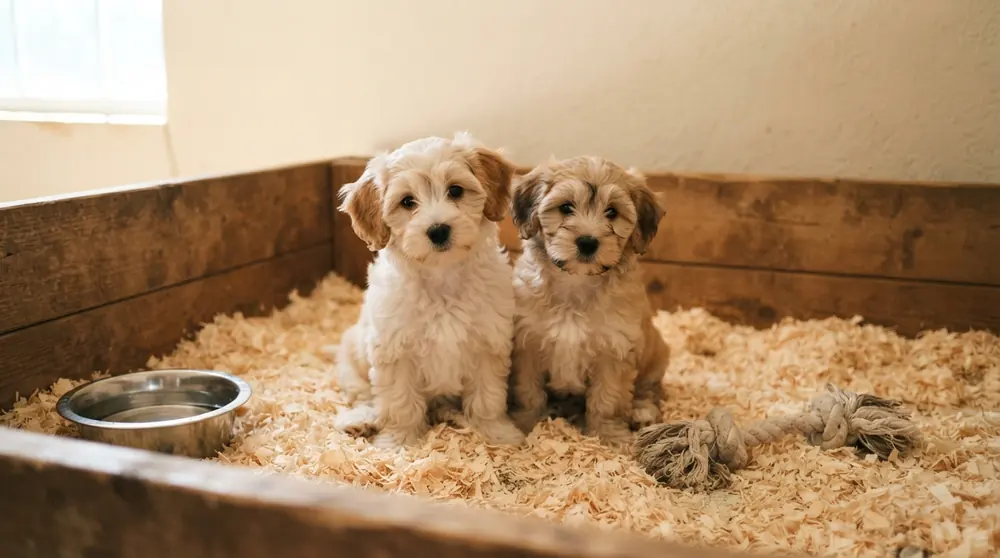
- Clause 24 sets a rest period. An imported animal may only be sold after it has rested at least 72 hours in Singapore, unless it was quarantined at the AVS station.
- Clause 17 limits the sourcing. Puppies may come only from AVS licensed breeding establishments and shops, from overseas imports, or from AVS approved sources.
None of that accuses anybody. It is the set of questions a licensed seller is already required to be able to answer.
What a licensed Singapore breeder can be held to
The asymmetry is worth naming. AVS conditions bind the Singapore licensee, and the regulator publishes two numbers any buyer can hold that licensee to.
For a puppy bred overseas, those questions belong to another country’s regulator, and the honest answer at the pen is the breeder’s name and the export paperwork. The licensed premises here are on the public AVS registry, all at Sungei Tengah[4] .
Why the unlawful route exists at all
Smuggled puppies use the same adverts as imported ones
The lawful Schedule III route costs a rabies vaccination, a serology test, a 90-day wait, a booking and 30 days of quarantine. That is the whole economic argument for the unlawful one, and it is why the cases that reach court almost all involve the land border.
The published cases, and what was found in them
These are the reported cases rather than an estimate of the trade. They say nothing about any particular seller, and are not offered as a comment on one.
- At Tuas in March 2025, officers found three sedated puppies hidden in a backpack inside a motorcycle storage compartment. All three tested positive for canine parvovirus and one for canine distemper, and the man was jailed 18 weeks[5] .
- Five Pomeranian puppies seized at Woodlands on 27 December 2023 all tested positive for parvovirus. The couple who sold smuggled Malaysian puppies from an HDB flat were jailed in 2026, the first custodial sentences here for keeping animals for sale at unlicensed premises[6] .
The questions that separate a legal import from a smuggled puppy
- Where are the premises, and what is the licence number? A void deck is not premises.
- Was this puppy imported, and may I see the import permit copy?
- When did it arrive, and has it rested the 72 hours?
- May I scan the microchip and match it against the records?
A licensed seller can answer all four from a file. That is the point of the clauses rather than a test we invented.
After arrival: the licence, the jabs and the first vet visit
Every dog kept in Singapore needs a licence, and the fee turns on the dog’s age and on whether it has been sterilised[8] . The rules on licensing a dog in Singapore sit on their own page.
- Take the export health certificate and the vaccination record to the first local vet visit.
- Expect an imported puppy’s course to be read against Singapore guidance, not against the export paperwork.
- Deworming, the microchip and the vet check are inside the puppy price here[9] .
If a bigger dog is the plan, the same conditions apply from the same countries, and the Golden Retriever puppies we list follow the route described on this page.
Before you book anything
Import dog to Singapore, and the questions that follow
The questions the live results ask, answered from the AVS conditions or handed to whoever really owns them.
How much does it cost to import a dog to Singapore?
The AVS import licence is S$50 on normal service or S$100 on express, and it is valid 90 days with no extension. Arriving without a booked inspection appointment costs S$133 per hour or part thereof. Airline, crate, agent and quarantine charges vary and we quote none of them.
How much does it cost to get a dog imported?
The same two government fees apply whoever handles the move. The private side, meaning the agent, the crate and the freight, is not published anywhere and is not ours to quote, so ask two AVS-recognised pet agents rather than trusting one figure from a forum.
Can I get GST relief for importing a pet into Singapore?
A Customs In-Payment permit for Goods and Services Tax may be required before arrival and is valid 10 working days from approval. Relief sits with Singapore Customs under its change-of-residence rules, not with AVS, so that is the office to ask.
Can I bring my dog to Singapore from Malaysia by car?
Lawfully, yes, through Tuas Checkpoint with a booked inspection. Malaysia is not listed in Schedule I or Schedule II, so it falls under Schedule III: rabies vaccination, a serology test, a rabies dose on arrival and at least 30 days of post-arrival quarantine.
What are the requirements for bringing a dog to Singapore?
An ISO microchip, a minimum age of twelve weeks at export, valid core vaccinations, a Singapore dog licence, an AVS import licence, a Customs permit, a booked border inspection and a government-endorsed veterinary health certificate. Rabies steps depend on the country category.
How long is quarantine for dogs in Singapore?
None from a Schedule I country when the animal is fully compliant. At least 10 days from Schedule II unless two exemption conditions are both met. At least 30 days at the Animal Quarantine Centre from Schedule III.
How much does a dog flight ticket cost?
Airlines set that and we do not quote it. What AVS fixes is the container: it must comply with the International Air Transport Association live animal regulations, and soft bags are not allowed for the transfer from the airport to the quarantine station.
Which airline is most pet friendly?
Not a question a dog farm should answer. AVS does require a signed captain’s declaration from the transporting airline for Schedule I and Schedule II imports, so ask the airlines that actually fly your route whether they will endorse one.
Does Singapore have a pet passport?
No. There is no passport scheme here. Each animal travels on its own import licence, health certificate and vaccination records, and the import licence lapses 90 days after issue with no extension available.
How do I know whether a puppy for sale here was imported?
Ask, and then ask to see the import permit copy a licensed pet shop must keep under clause 18. An imported animal may only be sold after resting at least 72 hours in Singapore, unless it came out of quarantine at the AVS station.
One question, answered before you drive out
Ask us where a puppy was bred
We will tell you the country and the breeder before you spend an afternoon on it.
WhatsApp +65 8806 6180 with the breed you are looking at, or call 9792 1567. Ask whether the puppy was bred on site or brought in, and we will say which.
How a viewing works
Viewings run 12:00 to 18:00 daily at Sungei Tengah, by appointment, so the records are out before you arrive. Start from the farm’s front page for the breeds and the bands.
- Tell us the breed and whether you are in a flat, a condo or a landed home.
- Ask where the puppy was bred, and ask to see the record that says so.
- Nothing on this page is advice on an individual import; AVS is the authority on that.
Address, hours and the numbers
- Address
- 59 Sungei Tengah Road, Block L #01-19, Singapore 699014
- Hours
- 12:00 to 18:00 daily, by appointment
- +65 8806 6180
- Call
- +65 9792 1567
Keep reading: our guides for Singapore dog owners.
Sources
- Importing dogs and cats into Singapore
- Housing and Development (Animals) Rules 2024, The Schedule (applicable dogs)
- Pet shop licence conditions (1) Dogs and Cats, 15 August 2025
- Public registry of AVS-licensed pet breeders
- 33 per cent decrease in animal smuggling cases recorded in 2025
- Woman jailed in first case of illegal animal captivity and sale (NParks statement, 15 September 2026)
- Singapore vaccination guidelines for dogs and cats
- Dog and cat licence fees
- William Goh Pet Farm puppy care FAQ (farm rules)